Optimising the overall efficiency of equipment using predictive maintenance is a key step for manufacturing companies
Article by Paolo Stefanini
In pneumatic circuits, the causes of faults and malfunctions are fortunately concentrated in a few critical areas that are easy to identify and resolve. These include air leaks, usually found in pipes and joints, due to loose connections or damaged seals; irregular air flow, which could be caused by clogged filters or malfunctioning pressure regulators. Normally, it is sufficient to replace or clean the filter elements to ensure that the air is clean and free of impurities. Or from pneumatic actuators: if acylinder moves too slowly or has irregular movements, the fault could be due to excessive air restriction or leaks in the cylinder itself. Pneumatic valves may also be affected: blocked valves may have a faulty solenoid or be clogged with impurities. Simple regular cleaning helps to prevent these problems.
To begin with, every pneumatic circuit must have a compressed air treatment unit upstream of any component, complete with a pressure regulator (pressure switch), dehumidifier filter and, where necessary, a fluid (oil) lubrication system. Pressure gauges must always be in working order and accurately calibrated so that they measure the operating pressure accurately. A common problem is the obstruction of certain points in the system, which generally causes the pressure to drop to zero: in this case, simply clean the system, as many pneumatic tools have removable parts that can be cleaned or are equipped with filters. Damage can also come from the external environment, so it is necessary to take care and clean leaves and insects from the ventilation holes. Many pneumatic systems require a minimum volume for the outlet pipes: any reduction in space, even due to dirt, can cause fluctuations. Finally, pneumatic lines that are too long result in slow responses. In a nutshell, good cleaning and lubrication are an excellent start to making a system reliable: this is not a new rule and is common to all types of systems (mechanical, fluidic and electrical).

Air quality
If contaminated, compressed air can cause corrosion of pipes and components, deformation of seals and obstruction of nozzles, preventing the system from functioning properly. Based on the above, it can be deduced that the reliability of a pneumatic system depends largely on the quality of the air circulating in it. The main sources of compressed air pollution are moisture, oil and dust.
- Moisture: the air compressor draws in moist air containing water: after compression, the pressure increases and when it cools down again, condensation forms, which infiltrates the compressed air and causes corrosion of the pipes and components, compromising their performance
- Oil: some of the lubricating oil used by the air compressor mixes with the compressed air in the form of mist, vaporises when heated and enters the system with the compressed air, causing deformation of seals, air leaks, increased friction resistance, poor valve and actuator performance and environmental pollution
- Dust: dust in the atmosphere, rust particles inside pipes and rubbery debris from sealing materials can infiltrate the compressed air, causing moving parts to jam, nozzles to block, components to wear out faster, service life to be reduced and frequent breakdowns, with serious repercussions on system performance
Daily maintenance
Maintaining air quality starts with daily maintenance of the pneumatic system, a fundamental element in Japanese methodologies (Total Productive Maintenance), which mainly concerns condensate management and system lubrication.
Condensate management
Condensate management involves the entire pneumatic system, from the air compressor to the aftercooler, air tank, piping system, various air filters, dryers and automatic drains. As the temperature inside the pipeline drops during the night, causing further condensation, the condensate must be drained from the pneumatic devices through the air treatment unit before the production cycle resumes. Even in colder seasons, at the end of a work cycle, it is advisable to drain the condensate from all points to prevent freezing due to night-time temperatures below 0°C. Do not forget to check the automatic drain frequently to ensure it is working properly and that the water cup of the treatment unit does not contain excess water.
System lubrication
Even in a pneumatic system, all surfaces with relative movement, from control components to actuators, require lubrication. Inadequate lubrication can increase friction resistance, cause poor component performance, or lead to system leaks due to wear on sealing surfaces. The properties of the lubricating oil directly affect the lubricating effect. Typically, high-viscosity lubricating oil is used in high-temperature environments, while low-viscosity oil is used in low-temperature environments. If the temperature is particularly low, a heater can be installed in the oil pan to overcome the difficulty of fogging. The amount of oil varies depending on the shape, movement status and load size of the lubricated part. Always check that the oil mist generator is working properly. Its quantity is always greater than what is actually needed: if the amount of oil does not decrease, adjust the amount of oil dispensed in time; if the adjustment is ineffective, the oil mist generator must be repaired or replaced immediately.
Cyclical maintenance
The interval for scheduled maintenance is usually three months and includes some basic activities on the main components of the system, listed below:
- Piping: locating, identifying and repairing leaks in the circuit
- Valves: checking the directional control valve discharge, determining whether the amount of lubricating oil is adequate and whether there is condensation in the air. If lubrication is poor, check whether the oil mist generator specifications are adequate, whether the installation position is correct and whether the amount of oil dripping is normal. With regard to condensation, if a large amount is discharged, assess whether the filter installation position is appropriate or whether the condensation drain device is suitable and the condensation is being completely discharged. If a small leak is still found when the discharge port of the directional control valve is closed, this is often the early stage of component damage. After inspection, worn parts can still be replaced to prevent malfunction
- Directional valves: determine whether there are impurities in the mating parts of the iron core and armature based on abnormal sound during switching. Check whether the valve core is worn and whether the sealing parts are aged. Switch the directional valve repeatedly and observe the operation of the cylinder to determine whether the piston seal is good
- Pneumatic cylinders: check the exposed part of the piston rod to determine whether there are leaks in the corresponding part of the front cover. The results of the above inspections and repairs must be recorded for troubleshooting and major repairs
- Safety: check that the safety valve and emergency safety switch are working reliably. During periodic maintenance, the reliability of their operation must be confirmed to ensure the safety of equipment and personnel
- General inspection: the overhaul interval for the pneumatic system is one or more years. The main purpose is to check the performance and service life of each component and part of the system and to repair or replace components in parts that usually fail, eliminating all possible failure factors within the repair interval
Predictive maintenance
To be successful in the market, it is particularly important to maximise the productivity of individual machines and systems, i.e. the degree to which machines and systems are used to their full potential during scheduled production times. Losses in availability, performance and quality can thus be accurately identified and quantified. Industrial pneumatic systems generally require little maintenance; however, regular inspections and a minimum of preventive maintenance can prevent serious problems and significantly extend the operating life of the system. In any case, unplanned downtime is a key factor to be reduced or eliminated. But how can downtime be avoided? By addressing the root causes. In addition to human error and lack of materials, the causes are mainly to be found in sudden component failures, which could be avoided by improving the overall performance of the equipment. In particular, failures of small components, such as cylinders and other pneumatic tools, can be avoided through predictive maintenance. Traditional preventive maintenance tools, such as operational or machine data acquisition, have long been used for diagnosis and cause analysis. However, they have some disadvantages compared to predictive maintenance:
- they completely ignore a lot of data and correlations
- they are too complex and expensive in traditional programming
- they do not provide forward-looking forecasts
- they do not initiate measures at an early stage
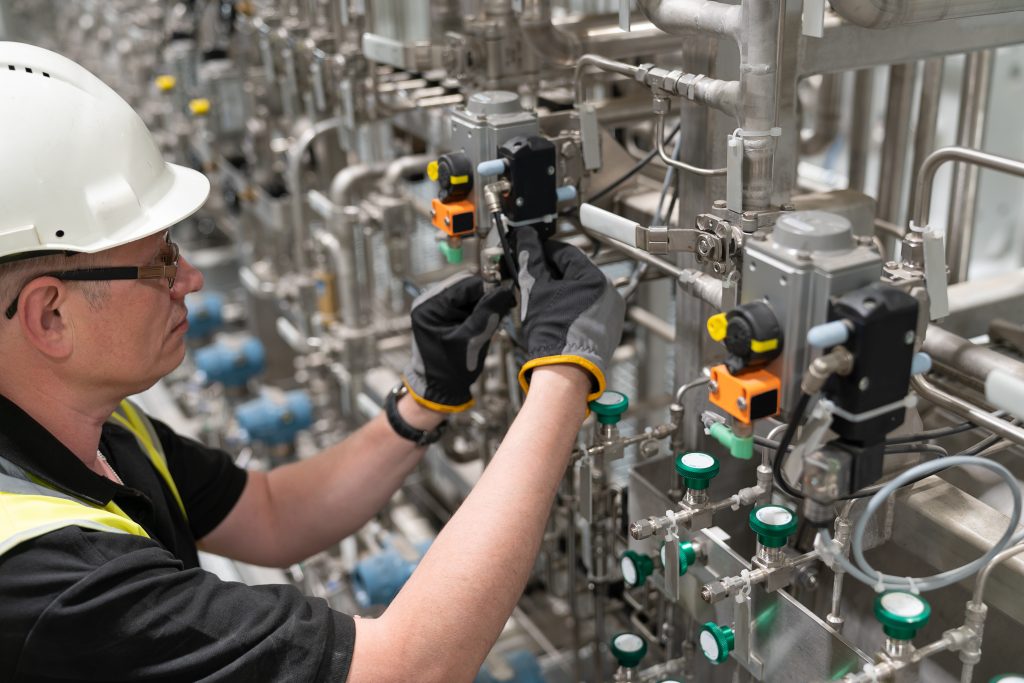
Predictive Maintenance Condition Monitoring allows weak signals, which are precursors to critical events, to be recognised in a timely manner. Sensors applied to machines and functional units collect data that is forwarded to the processing system (known as ‘artificial intelligence’). In this way, by constantly monitoring the status of pneumatic components, potential faults and system anomalies are identified. This allows corrective actions to be planned at minimum cost. Unplanned failures are thus avoided, as maintenance and servicing (spare parts, labour, intervention times, logistics) are optimised and initiated before anomalies occur.
In conclusion
Optimising the overall efficiency of equipment using predictive maintenance is a key step for manufacturing companies towards greater efficiency and competitiveness. Maintenance and servicing can be easily improved and unscheduled downtime minimised. The development of so-called artificial intelligence allows for the optimisation of production and the company’s core values. Future developments and trends, already well established, such as the Internet of Things (IoT) and machine learning, will continue to improve and spread predictive maintenance solutions. This means that companies already relying on artificial intelligence solutions will increase plant yield and secure a clear competitive advantage.